

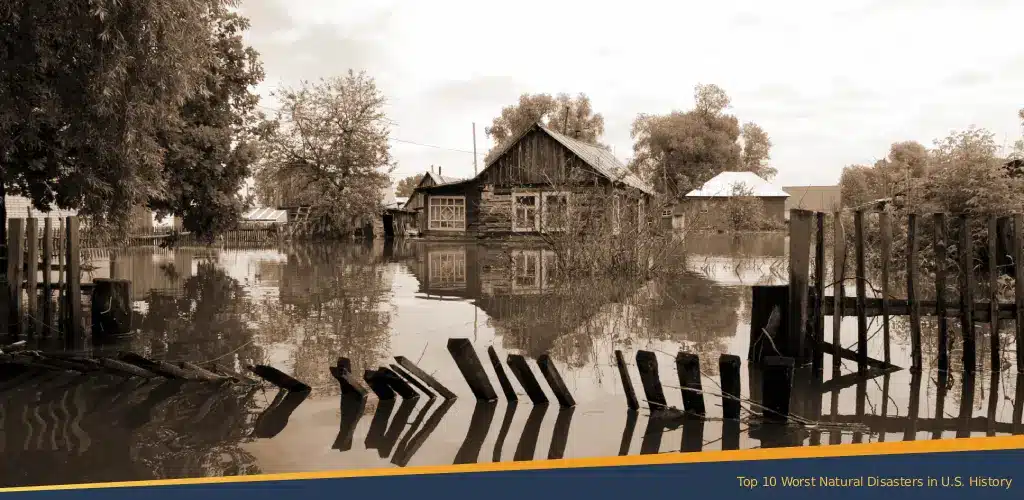
Natural disasters have shaped the American landscape—physically, socially, and legally. From hurricanes and earthquakes to floods and fires, these events have not only tested our resilience but also redefined safety standards, disaster policy, and liability laws.
Below, we explore the ten worst natural disasters in U.S. history, ranked primarily by loss of life, and examine how each reshaped American policy and law.
1. The 1900 Galveston Hurricane (Texas)
In September 1900, a Category 4 hurricane struck Galveston Island with winds exceeding 135 mph and a storm surge that swallowed the city. The storm flattened neighborhoods, destroyed the port economy, and left nearly a quarter of the city’s population dead. Between 6,000 and 12,000 people perished, making it the deadliest natural disaster in U.S. history.
In the years that followed, Galveston’s population shifted dramatically as many survivors relocated inland to Houston, transforming it into the new commercial and shipping center of the Texas Gulf Coast. The city’s economy never fully recovered, and insurance firms across the nation were forced to rethink risk: many went bankrupt paying claims, while others established the first actuarial catastrophe models and created stricter underwriting practices.
Municipal bonds were restructured to fund reconstruction, and Galveston’s once-thriving port ceded its dominance to Houston, which benefited from new investment and the expansion of the Houston Ship Channel.
The storm not only devastated lives but also permanently altered the economic and legal fabric of the Gulf Coast, reshaping both urban growth and the modern insurance landscape.
How It Changed Coastal Safety
The devastation led to the construction of the Galveston Seawall and the adoption of the Commission Form of Government, a pioneering model for municipal disaster management. It also inspired the federal government’s first coordinated hurricane forecasting and coastal engineering standards—laying the groundwork for modern flood prevention infrastructure.
2. The 1936 North American Heat Wave
Soaring temperatures over 110°F gripped the Midwest during one of the Dust Bowl’s harshest years. Entire crops withered, livestock perished, and energy systems buckled under the stress of sustained heat. Nearly 5,000 people died from heat-related illnesses and crop failure.
The heat wave exposed weaknesses in rural infrastructure and the lack of safety nets for farming communities.
How It Shaped Environmental Policy
The disaster accelerated passage of the Soil Conservation Act of 1935, spurring federal investment in irrigation, reforestation, and sustainable agriculture. It also gave rise to early public health campaigns warning about dehydration, sun exposure, and heatstroke—concepts that later evolved into today’s heat advisories and worker protection standards.
3. The 1906 San Francisco Earthquake & Fire (California)
The 7.9-magnitude quake struck before dawn, toppling buildings and rupturing gas lines that fueled days of fires across San Francisco. Nearly 80% of the city was destroyed, and more than 3,000 people were killed. Refugee camps sprang up across parks and open spaces as survivors struggled for months to rebuild.
California introduced the nation’s first seismic building standards and restructured fire insurance laws after insurers faced insolvency.
The event led to landmark research such as the Lawson Report and fueled early federal interest in seismic study, which ultimately contributed to the creation of the National Earthquake Hazards Reduction Program (NEHRP) in 1977, under which the USGS Earthquake Hazards Program now operates, shaping modern seismic policy and disaster risk modeling used worldwide today.
4. Hurricane Maria (Puerto Rico, 2017)
This Category 4 storm devastated Puerto Rico’s infrastructure, resulting in an estimated 2,975 deaths. Entire towns were cut off from medical care, electricity, and clean water for weeks, with some areas remaining dark for nearly a year. Maria revealed the vulnerabilities of U.S. territories—both physical and political.
How It Redefined Federal Disaster Accountability
Maria led to Stafford Act reforms and forced FEMA to overhaul its response systems. The storm prompted renewed debate on equity in aid distribution, as the crisis revealed delays in federal response and resource allocation. Today, federal emergency planning for territories includes revised funding formulas and stricter transparency standards.
5. The 1928 Okeechobee Hurricane (Florida)
When Lake Okeechobee’s levees failed, floodwaters swept across nearby farming communities, disproportionately impacting Black migrant laborers. Over 2,500 people were killed, and entire neighborhoods vanished beneath the flood.
The tragedy became a defining moment in U.S. flood policy, revealing racial disparities in disaster response and setting in motion federal intervention in flood management.
How It Inspired Flood Control and Environmental Justice
Congress passed the Rivers and Harbors Act of 1930, empowering the U.S. Army Corps of Engineers to build new levees and drainage systems. The storm’s legacy also catalyzed early environmental justice efforts, recognizing the human cost of poor infrastructure planning in marginalized areas.
6. The 1889 Johnstown Flood (Pennsylvania)
After days of heavy rainfall, the poorly maintained South Fork Dam gave way, unleashing 20 million tons of water that roared through Johnstown at 40 mph. The wave demolished entire neighborhoods and left 2,209 people dead. Survivors described a scene of total ruin—bridges piled high with debris and fires that burned for days.
How It Changed Corporate Liability and Engineering Ethics
Public outrage over the dam’s private ownership and neglect inspired national debate over industrial responsibility. The flood influenced early tort law principles and spurred the creation of professional engineering ethics, emphasizing safety, maintenance, and the duty of care.
7. The 1871 Peshtigo Fire (Wisconsin)
On the same night as the Great Chicago Fire, a far larger blaze consumed northeastern Wisconsin. Driven by hurricane-force winds, the fire burned over a million acres and killed between 1,200 and 2,500 people—many trapped in rivers or root cellars trying to escape the flames.
How It Built America’s Forest Policy
The destruction prompted the creation of state forestry commissions and laid the groundwork for the U.S. Forest Service (1905). The fire led to new federal forest management programs and better firefighting and prevention policies were developed in the area and adopted by other communities and logging companies.
8. The 1893 Sea Islands Hurricane (Georgia & South Carolina)
This Category 3 storm brought 16-foot storm surges to coastal islands, destroying plantations and homes. Between 1,000 and 2,000 people—mostly freedmen—lost their lives. The hurricane revealed how poverty and isolation amplified disaster risk.
How It Shaped Federal Relief Efforts
The American Red Cross’s large-scale deployment to the Sea Islands marked the birth of organized national disaster relief. It paved the way for federal-state collaboration and set precedents for long-term recovery programs that would later fall under FEMA’s mission.
9. The 1925 Tri-State Tornado (Missouri, Illinois, Indiana)
The deadliest tornado in U.S. history carved a 219-mile path of destruction, leveling entire towns and killing 695 people. Communities were blindsided with no warning systems in place, and the storm’s speed—nearly 70 mph—made survival nearly impossible.
How It Advanced Weather Forecasting
The disaster highlighted the need for better meteorological research and led to significant improvements in tornado forecasting and warning systems, a goal that has been pursued by studying historical tornadoes like the Tri-State event.
10. The 1938 Great New England Hurricane
This fast-moving storm, later dubbed the Long Island Express, flooded coastal towns, uprooted forests, and caused over 600 deaths. The destruction extended from Long Island to Maine, crippling infrastructure for months.
How It Strengthened Hurricane Tracking and Flood Preparedness
In response, Congress funded the Hurricane Warning Network and expanded coastal evacuation systems. The event inspired the creation of the National Hurricane Center and fueled early discussions about a federal flood insurance program, eventually realized in the 1960s.
By the Numbers: America’s Costliest Disasters
While the deadliest disasters took the most lives, the costliest reshaped the economy and insurance landscape. According to NOAA’s inflation-adjusted data:
- Hurricane Katrina (2005) – $200+ billion
- Hurricane Harvey (2017) – $160 billion
- Hurricane Ian (2022) – $120 billion
- Hurricane Maria (2017) – $115 billion
- Hurricane Sandy (2012) – $88 billion
These economic tolls spurred major reforms in federal flood insurance, FEMA protocols, and the private reinsurance market, reinforcing the financial side of disaster preparedness.
Why Death Counts Differ
Historical underreporting and inequities in recordkeeping, particularly among marginalized communities, obscure true death tolls. Indirect fatalities—those from infrastructure collapse or delayed medical care—often go uncounted. Recent disasters like Hurricane Maria show how modern excess mortality studies now provide a fuller understanding of human loss.
Resilience and Recovery
Each event reshaped how the U.S. plans, funds, and legislates disaster response. From the creation of FEMA (1979) to the National Flood Insurance Act (1968), these catastrophes collectively built today’s emergency management system. Yet, increasing storm intensity underscores the continuing need for strong policy, equitable aid, and reliable insurance coverage.
What History Teaches About Preparedness
Every disaster tells two stories: one of loss and one of progress. The laws, safety codes, and relief systems that protect us today were often born from tragedy. When disaster strikes, recovery depends on both resilience and advocacy—ensuring that families and businesses receive every dollar they’re entitled to.
Knowing your rights matters just as much as knowing the risks. If you’re facing an insurance dispute after a major loss, Daly & Black, P.C. can help you pursue the compensation owed to you under your policy.