

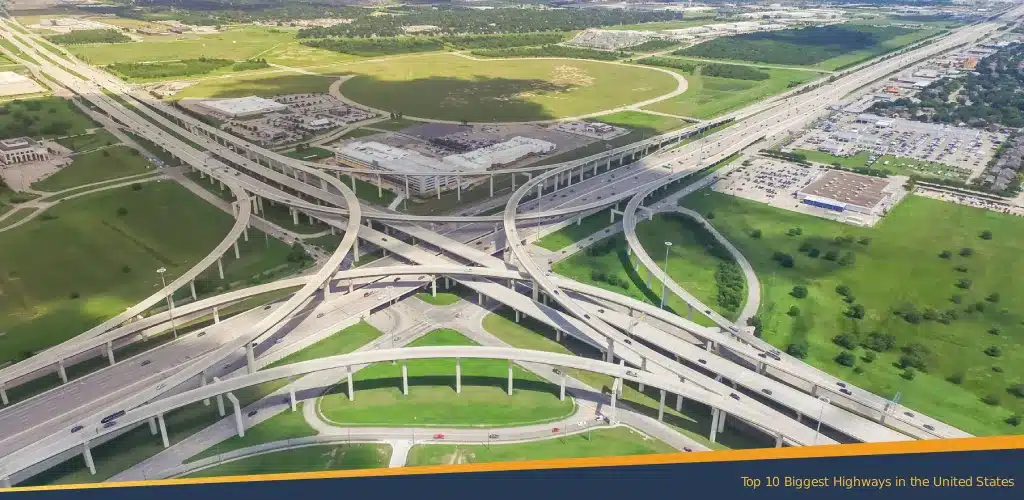
Highways are the arteries of America’s transportation system, stretching thousands of miles across diverse landscapes and connecting millions of people daily.
With more than 48,000 miles of interstate highways in the U.S. (FHWA), these roads aren’t just routes for travel—they’re vital for commerce, emergency response, and national connectivity.
Below, we break down the biggest highways in the United States by length and scale, providing insights into their history, significance, and impact.
What Defines the “Biggest” Highways?
The “biggest” highways can be defined in several ways:
- Mileage: The longest continuous routes across states.
- Capacity: The widest highways handling the largest traffic volumes.
- Economic Impact: Highways are central to freight, commerce, and disaster evacuation.
By considering both length and capacity, we can identify the true giants of America’s road system.
The 10 Longest Highways in the U.S.
Before diving into the list, it’s worth noting that these highways aren’t just long stretches of road—they each play a unique role in shaping commerce, travel, and culture across America. From coast-to-coast routes to historic corridors, the following highways represent the true giants of the nation’s road network.
U.S. Route 20 (3,365 miles)
Stretching from Boston, Massachusetts, to Newport, Oregon, Route 20 is the longest road in America. Established in 1926 as part of the original U.S. Highway System, it crosses 12 states and weaves through major cities like Chicago and Toledo. Its sheer length makes it the backbone of coast-to-coast travel.
U.S. Route 6 (3,207 miles)
Nicknamed the “Grand Army of the Republic Highway,” Route 6 was once the longest U.S. highway, holding that title between 1937 and 1964 when it stretched coast-to-coast from Provincetown, MA to Long Beach, CA. In 1964, its western terminus was shortened to Bishop, CA, where it still ends today, but it remains one of the most historic and significant U.S. Routes since its designation in 1926.
U.S. Route 30 (3,073 miles)
Beginning in Atlantic City, New Jersey, and ending in Astoria, Oregon, Route 30 covers 11 states. It parallels much of the historic Lincoln Highway, America’s first transcontinental road, which was incorporated into the U.S. Highway System in 1926.
U.S. Route 50 (3,011 miles)
Known as “The Loneliest Road in America” across Nevada, Route 50 stretches from Ocean City, Maryland, to Sacramento, California. Established in 1926, it crosses mountain ranges, deserts, and farmland, and has long symbolized the American spirit of cross-country travel.
Interstate 90 (3,020 miles)
The longest Interstate Highway, I-90, runs from Seattle, Washington, to Boston, Massachusetts. Completed in 1956 as part of the Interstate Highway Act, it connects key northern cities, making it vital for freight and passenger travel in the northern U.S.
Interstate 80 (2,900 miles)
Spanning from San Francisco, California, to Teaneck, New Jersey, I-80 is the second-longest interstate. Authorized under the 1956 Federal-Aid Highway Act, it closely follows the historic Lincoln Highway and remains one of the most heavily traveled routes for long-haul trucking.
Interstate 40 (2,555 miles)
Running from Barstow, California, to Wilmington, North Carolina, I-40 was authorized under the 1956 Federal-Aid Highway Act but not fully completed until June 29, 1990, when the final segment in North Carolina was dedicated. It crosses eight states and passes through cultural landmarks like Nashville, Memphis, and Albuquerque, with much of its western stretch following the historic Route 66.
Interstate 10 (2,460 miles)
As the southernmost coast-to-coast highway, I-10 runs from Santa Monica, California, to Jacksonville, Florida. Built largely after the 1956 Interstate Act, it serves as a critical evacuation route for hurricanes along the Gulf Coast. During major emergencies, authorities sometimes implement a traffic-management strategy known as contraflow, where every lane is temporarily redirected in one direction to move vehicles away from the coast.
U.S. Route 1 (2,369 miles)
From Fort Kent, Maine, to Key West, Florida, U.S. Route 1 was established in 1926 and hugs the East Coast. As one of the oldest highways, it has long been iconic for connecting the Atlantic seaboard’s cities and communities. Interestingly, large portions of U.S. 1 follow paths first laid out in the colonial era, including Boston Post Road, making it not just a modern artery but also a living piece of American history.
Interstate 70 (2,153 miles)
Stretching from Cove Fort, Utah, to Baltimore, Maryland, I-70 was one of the first long-haul interstates constructed after the 1956 Interstate Act. It is an essential east-west corridor, cutting through the Rocky Mountains and the Midwest and serving as a critical link between regions.
Biggest Highways by Capacity
While length is impressive, capacity tells us which highways can handle the most vehicles at once. Here are three of the widest highways in the U.S., earning honorary mention:
Katy Freeway (Houston, TX)
With up to 26 lanes at its widest point, the Katy Freeway is officially the widest freeway in the world. This expanded section of I-10 is a testament to Houston’s rapid growth and the city’s heavy reliance on car travel. It serves as a key artery for commuters and freight moving in and out of one of America’s largest metropolitan areas.
Downtown Connector (Atlanta, GA)
The Downtown Connector is where I-75 and I-85 merge through the heart of Atlanta. With more than 14 lanes of traffic, it is both a marvel of infrastructure and a source of legendary congestion. It plays a critical role in connecting regional traffic across the Southeast while funneling hundreds of thousands of commuters into Atlanta daily.
Interstate 405 (Los Angeles, CA)
Perhaps the most famous freeway in America, the 405 runs north–south through Los Angeles and is central to the region’s transportation network. While notorious for its gridlock, its width and connectivity make it indispensable, linking communities, airports, and major commercial hubs across Southern California.
Biggest Highways by Economic Impact
Some highways may not top the list in length or width, but are unmatched in economic importance:
Interstate 95 (East Coast Corridor)
Running from Miami, FL to Houlton, ME, I-95 links nearly the entire Eastern Seaboard. It is the busiest interstate in America, carrying both massive commuter traffic and freight volumes. It connects major metropolitan areas such as Miami, Washington, D.C., Philadelphia, New York City, and Boston, making it indispensable for the East Coast economy.
Interstate 5 (West Coast Corridor)
Stretching from San Diego, CA, to Blaine, WA, I-5 is the backbone of West Coast trade. It links agricultural hubs in California’s Central Valley with international ports in Los Angeles, Seattle, and Tacoma. This corridor is vital not only for domestic commerce but also for international shipping across the Pacific.
Interstate 35 (NAFTA Highway)
Extending from Laredo, TX, on the U.S.–Mexico border to Duluth, MN, I-35 is a key route for international trade under the USMCA (formerly NAFTA). It facilitates billions of dollars’ worth of goods moving between Mexico, the U.S., and Canada. Beyond freight, it also connects major U.S. cities like San Antonio, Dallas, Oklahoma City, and Minneapolis.
The Most Dangerous Highway in America
While size and economic importance define highways in impressive ways, danger is another reality worth noting. According to multiple safety studies, Interstate 95 consistently ranks as the most dangerous highway in the U.S. for accidents and fatalities.
Stretching along the East Coast, its heavy traffic volumes, dense urban stretches, and high-speed travel contribute to a disproportionate number of crashes each year.
For drivers, this underscores how essential it is to stay vigilant and understand the risks of major highways. For victims and their families, it also highlights why legal guidance can be critical when navigating the aftermath of a serious accident.
Why Highways Matter Beyond Travel
Highways are more than roads; they’re lifelines:
Economic Significance
Highways carry most U.S. freight, making them essential for business and supply chains. Without them, national and regional economies would grind to a halt, as they enable the smooth flow of goods, fuel, and raw materials.
Disaster Response
FEMA identifies major highways as primary evacuation routes during hurricanes, wildfires, and floods. A vivid example came during Hurricane Katrina in 2005, when interstates like I-10 and I-59 became critical lifelines for evacuees fleeing New Orleans. Their strategic placement ensures millions of Americans can relocate quickly and safely in times of crisis.
Legal & Insurance Implications
Highways see higher accident rates due to traffic density. Navigating insurance claims after highway accidents often requires legal support, as disputes with insurers can complicate recovery for victims.
The Backbone of America’s Road System
The biggest highways in the United States are more than engineering feats—they’re the infrastructure that fuels commerce, connects communities, and saves lives during emergencies. From the coast-to-coast span of Route 20 to the massive lanes of Houston’s Katy Freeway, these roads represent the scale and complexity of America itself.
When accidents or disasters strike on these highways, Daly & Black is ALL IN to help victims pursue the full compensation they may be entitled to. Our firm stands ready to guide clients through the complexities of insurance disputes and legal claims tied to highway-related losses.